

Culture Works
Culture Works – how? It has long been acknowledged that creativity can assist health and wellbeing and culture can encourage tourism. Recently there has been activity on the art front, this is an update of current and ongoing projects.
Hidden Coast – Cumbria
During February 2020 The Haverigg Lighthouse Centre hosted Copeland Council’s consultation event with Eric Barker, Coastal Programme Officer at Copeland Borough Council for an ambitious public art project to for the Copeland Coast and wider borough, called the ‘Connecting Cumbria’s Hidden Coast’ public art programme.
The project, which is being curated by Aldo Rinaldi and Deborah Smith, in the world of art, both are very well-known curators on the national and international scene. It will involve a broad public art strategy for the Borough including a series of art interventions in the landscape, temporary and permanent and a major landmark ‘world-class artwork’ for the region, funded by Coastal Communities Fund, and Sellafield Ltd.
Following on from this Aldo has been in touch with Millom Arts and Crafts and had discussions with artist Irene Rogan requesting information on artists in the region including contemporary poets and writers and the Norman Nicholson Society. This is an initial process of evaluation which will continue throughout the commission.

My ideas around Cumbria (coast) are the landscape, so land art, ecology, farming, geology and its history of mining, and of course nuclear landscape. I am also of the mind that the arts in the area are under-represented and that helping to support that longer-term are important, however, that is part of the aim here, of the programme, to draw interest in the area, and tourism, which can then influence interest. In the west country, at Bruton, (the gallery arrival there and garden (Hauser and Wirth https://www.hauserwirth.com) has really caused a blossoming of interest by artists, and studios, and craft, and triggered output and interest. Or rather the visitors to the area, look at wider arts scene. We need to think a bit like that here I think, and how an art programme can help to develop a scene, and not just individual works. Aldo Rinald
Having established a conversation with the Hidden Coast, the aim is to receive continued inclusion in developments and further consultations with the project.


Information
Led by Copeland Council, the Hidden Coast project will receive just over £1million funding from the Government’s Coastal Communities Fund as announced by Jake Berry MP. Sellafield Ltd will also provide £605,000, with further partner support coming from Cumbria County Council, Natural England, Muncaster Castle and the Western Lake District and Coast Partnership.
Largely following the route of the designated English Coastal Path, the connected challenge route project will see a cyclists’ crossing created over the River Irt to fill a current gap in the path to remove a 6km detour.
Phase One will include:
A permanent hub at Silecroft beach that will house a café and toilet/shower facilities with a design currently in the public realm to view
An augmented climbing wall at Muncaster Castle
Links to Wheels for All Hub, an inclusive cycling centre
1.4km of new cycle path and 1.8km of new or improved footpaths
10 art installations
Digital apps, signage and maps
Hopes are high that the project can attract funding for Phase Two with further adventure activities of kite surfing or sea kayaking from the Silecroft hub, in addition to art installations. This exciting project showcases one of Britain’s hidden gems – West Cumbria’s stunning coastline. The project will build on the best of our past to create new opportunities to grow and diversify our local economy.

Julie Betteridge, Copeland Council’s Executive Director, Operations, said: “We are thrilled that we have received the funding for this unique project which gives us an exciting opportunity to develop and diversify the economy, and in doing so, connecting our coast to the Lake District National Park.
The project will not only create a physical challenge route, but will enable people to explore Copeland’s art, culture and heritage using the natural environment. It also supports our residents and industries through the provision of a sustainable travel-to-work option.
This exciting project showcase one of Britain’s hidden gems – West Cumbria’s stunning coastline. The project will build on the best of our past to create new opportunities to grow and diversify our local economy.
As we all know Millom and Haverigg needs to keep eyes on this, in order not to be overlooked. Any news on further developments will be passed on
https://www.copeland.gov.uk/node/42763
Stone Carving Duddon Estuary – a legacy project
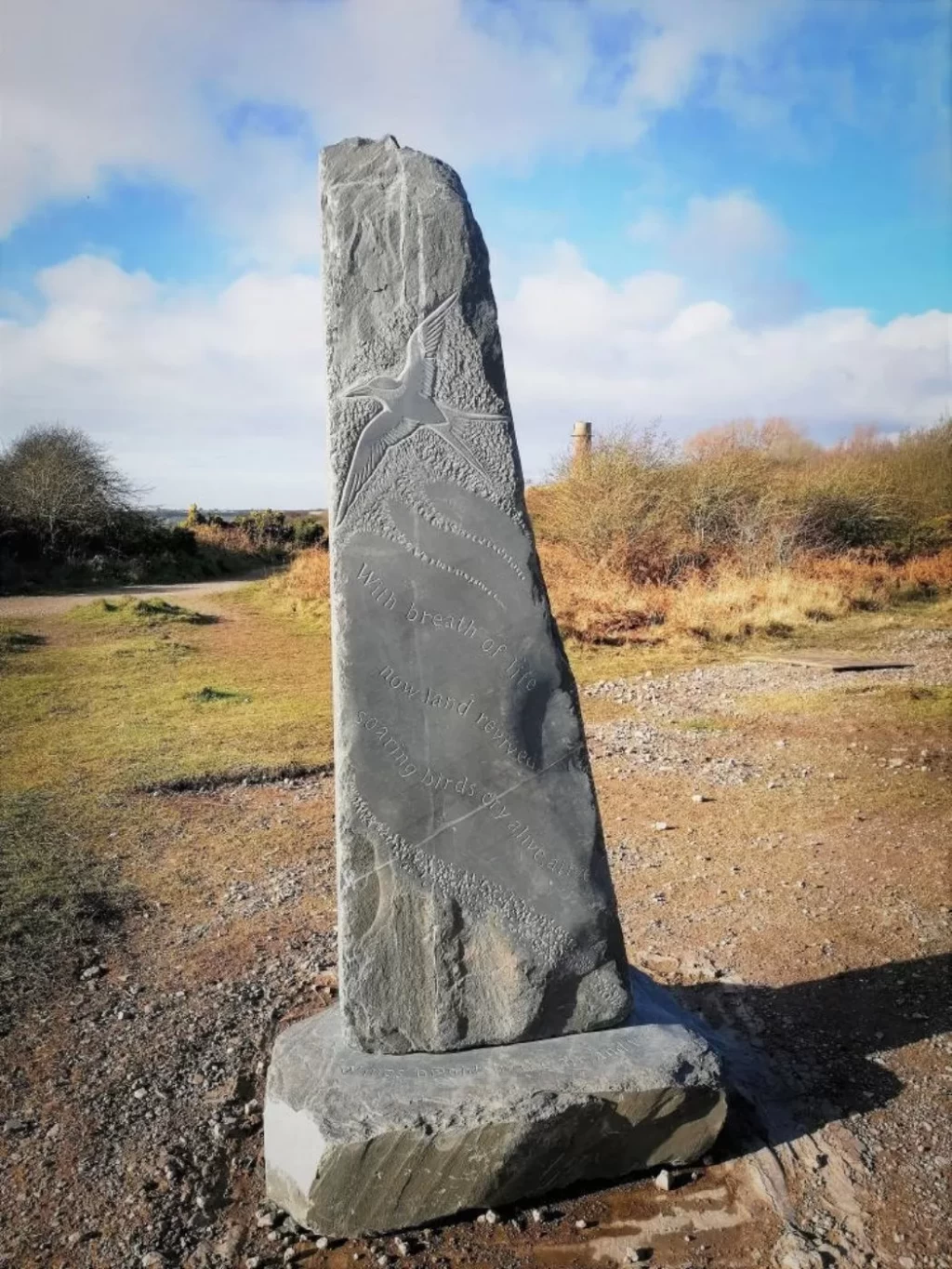
An Arts Council of England Award, Ghyll Scaur Quarry Community Fund, Burlington Slate Ltd and Beckside Farm, Whicham Valle providing large workspace and facilities were offered to artist Irene Rogan making it possible to develop a series of slate carved standing stones along the Duddon estuary initially for Millom, RSPB Hodbarrow and The Green, with possibilities for Kirksantion and Silecroft. The project titled ‘Between Silence and Light’ creates a connection between heritage and culture through carved slate linking the many ancient standing stones in the area
Each stone approximately six to seven feet high and is carved with design and text, referencing their locations and very short poetic phrases lifted from Norman Nicholson (copyright agreed) and Wordsworth and contemporary poets. Irene invited Danny Clahane, a gifted stone sculptor with thirty years’ experience to work with her. The project was able to provide free, stone carving workshops for local communities in Millom, Silecroft and The Green.
The stone carving talent displayed by locals was remarkable and the works by locals were exhibited in a temporary pop-up gallery NO 32. Participants included those from MIND, young children, young adults and older people, a truly intergenerational event. This work was accompanied by Jem Freiesleben’s photographic exploration of the stone circles with beautiful A1 posters for each location and a video of artists carving the slate stones at Becksides Farm.
A shop on Lapstone Road was offered courtesy of Ravenstonecroft trustee George Gledhill, rent-free who were unaware of the shops’ condition and were pleased to provide a temporary arrangement for a free exhibition space. The project volunteers helped with cleaning, repairing of interior walls and painting to create a temporary gallery space. This proved a boon to the owners, as the art exhibition considerably enhanced the shop and attracted several requests concerning leasing. Between Silence and Light exhibition was open during the Christmas period, (with help from volunteers) and visitors, from local and regional areas were delighted to see a ‘gallery’ in Millom displaying such high-quality work by local artists and the residents.
In the meantime, RSPB Hodbarrow’s stone has been installed, Millom Town Council has taken ownership of the Millom stone following a brief informal handover with Mayor Angela Dixon and Robert Morris-Eyton, Beckside Farm, just prior to the lockdown. United Utilities offered Irene a location on the Banking, Millom for the Millom Stone. The Green’s stone was almost complete.
All community celebrations for installation of the slate stones has been postponed, there will be an official unveiling as and when COVID-19 situation allows.
Times
The national newspaper featured an article in its Politics pages on 28th February 2020 about the Arts Council of England’s ‘rebranding’ and later citing Moving Mountains Art 2018, Millom as an exemplar project, for a moment putting Millom on the national cultural map. However, many artists around the country have taken issue with the Arts Council’s re-branding to remove the word ‘Artist’, from their commissioning publicity only for the North, with the notion these populations cannot cope with the word and feel intimidated by it, when all know many people particularly in Millom and surrounding areas, consider themselves to be Artists, not requiring Arts Council of England endorsement.. Irene Rogan sent a response letter to the Times 9not printed), more recently Arts Council office for the North were made aware of her concerns, it is very encouraging to be told that they wished to have a discussion and potentially revise their strategy due to opposition of regional artists. As with everything this occurred just prior to lockdown and other critical events took priority.
Art Diary
Dynamic Dunescapes – HAVERIGG
Dynamic Dunescapes is an exciting and ambitious project, rejuvenating some of England & Wales’ most important sand dunes for people, communities and wildlife.
Many of us know and love sand dunes as beautiful coastal landscapes, but they are also important biodiversity hotspots. These dunes are a sanctuary for rare species which are perfectly adapted to live in the sand. At a healthy dune, you could find orchids, toads, birds and lizards thriving!
But these special creatures are at risk. Over time, many sand dunes have become covered by grass and scrub which have stabilised the sand too much, and invasive species have overtaken native ones. We now know that a dune environment needs areas of freely moving sand, healthy sheltered dune slacks and areas with low vegetation to support its diverse wildlife. We are using pioneering conservation techniques to rejuvenate the dunes and make their shifting sands the perfect home for our threatened wildlife again.
Art & Environment The project manager for this region Eve Mulholland has discussed ideas concerning creative workshops for local communities to engage with the project.
Dynamic Dunescape Project Objectives
1. Deliver direct evidence-based management and interventions on project sites that will make a demonstrable and sustainable improvement for the conditions and processes needed to support dune habitats and species.
2. To build an understanding and appreciation of sand dunes as a naturally dynamic habitat
requiring conservation interventions.
3. To ensure more people and a wider range of people are involved with sand dunes and
through their involvement learn about, enjoy and value sand dunes.
4. To develop the skills of individuals and organisations to better manage dunes both now and in the future.
5. Establish strong networks so that lessons learnt from the project (both conservation and
people engagement) are shared and disseminated, building a lasting legacy for sand dunes.
Please visit this very attractive website for more detail
Art events are postponed, updates will be listed in the next issue.


